Vintage Stache: The Sketch-Style Dingbats Font That Bridges Playfulness and Purpose
Typography is rarely just about letters—it’s about voice, texture, and intention. In a digital landscape saturated with sleek sans-serifs and polished serifs, Vintage Stache stands apart not as a traditional text font, but as a visual language: a dingbats font rendered in a warm, hand-drawn sketch style. It doesn’t spell out paragraphs—it punctuates ideas, frames moments, and adds tactile authenticity to designs that demand personality over polish. Whether you’re hand-lettering a wedding suite or prototyping a craft brand’s identity, Vintage Stache operates at the intersection of nostalgia and utility—offering expressive glyphs that feel both spontaneous and intentional.
What Makes Vintage Stache Distinctive—Beyond “Just Another Dingbat”
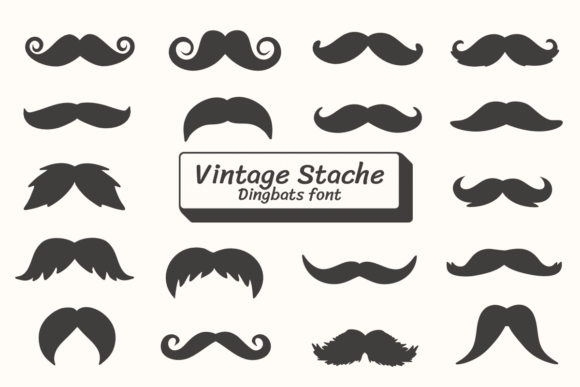
Dingbats fonts—collections of symbols, ornaments, and decorative elements—have long served as design shorthand. But most fall into predictable categories: geometric, ornate, or minimalist. Vintage Stache diverges by embracing imperfection as a feature, not a flaw. Its glyphs—whiskers, mustaches, bowties, pocket watches, ink blots, vintage microphones, and stylized florals—are drawn with visible line variation, slight wobbles, and deliberate asymmetry. This sketch-style execution evokes the energy of a designer’s notebook: quick, confident, and human-scaled.
Unlike vector-perfect icons, Vintage Stache’s irregular contours create subtle visual rhythm when repeated. A border built from its repeating motifs doesn’t feel mechanical—it breathes. Its weight distribution (light-to-medium stroke contrast) ensures legibility at small sizes while retaining charm at large scales—critical for applications like signage or fabric printing. And because it’s designed as a Unicode-compliant dingbats font, it integrates seamlessly into standard design workflows: no special software plugins, no SVG imports—just select, type, and scale.
Real-World Applications: Where Sketch Meets Strategy
The strength of Vintage Stache lies not in theoretical appeal, but in how naturally it solves recurring creative challenges across disciplines.
Wedding & Event Design: Authenticity Over Cliché
Couples increasingly reject cookie-cutter elegance in favor of warmth and narrative. Vintage Stache delivers that through detail—not grandeur. Consider a save-the-date card where the date is framed by two hand-sketched pocket watches instead of generic flourishes. Or invitation suites where monograms incorporate tiny mustaches or bowties as integrated accents, reinforcing a lighthearted, character-driven theme. Because each glyph retains individuality—even when duplicated—the result feels bespoke, not templated. Designers report higher client engagement when using Vintage Stache for mood boards: it communicates tone faster than color palettes alone.
DIY & Craft Communities: Scalable Creativity for Non-Designers
Hobbyists using cutting machines (Cricut, Silhouette) or print-on-demand platforms benefit from Vintage Stache’s practical structure. Its glyphs are optimized for clean cut lines—no fragile interior details that snag vinyl or misfire on embossing tools. A single “stache” glyph can become a coaster motif, a mug decal, or an embroidered patch outline—all without needing vector tracing or manual cleanup. Educators teaching design fundamentals use it to demonstrate hierarchy: students layer Vintage Stache borders beneath serif body text to explore contrast without relying on complex layout software.
Branding & Small Business Identity: Subtle Storytelling
For local cafes, artisan bakeries, or indie record labels, Vintage Stache offers low-risk visual differentiation. A coffee shop might use its steam-cloud glyph as a subtle watermark behind menu headers; a vinyl shop could integrate its microphone icon into a “Now Playing” badge. Crucially, it avoids the datedness of full retro revivals—it references mid-century sketch culture without mimicking it. Business owners appreciate that it conveys approachability without sacrificing professionalism: it signals “we care about craft” without shouting “vintage!”
Educational Materials & Research Visuals
In academic or nonprofit contexts, data visualization often suffers from sterile abstraction. Researchers illustrating oral history projects have used Vintage Stache’s ear, speech bubble, and quill glyphs to annotate timelines—adding human context to statistical charts. Teachers designing classroom posters replace generic clip art with its chalkboard-style arrows and lightbulbs, reinforcing concepts through consistent, memorable iconography. The font’s sketch aesthetic lowers cognitive load: viewers process symbols faster when they resemble familiar hand-drawn cues rather than abstract glyphs.
Workflow Integration: Practical Considerations for Diverse Users
Adopting any new typographic asset requires evaluating technical fit—and Vintage Stache excels here through thoughtful engineering.
- Cross-platform compatibility: Works natively in Adobe Creative Cloud (Illustrator, InDesign, Photoshop), Affinity Suite, Canva (via upload), and web CSS via @font-face—no font substitution fallbacks needed.
- Character mapping: Glyphs are assigned to standard Unicode Private Use Area (PUA) slots, meaning designers can access them reliably through glyph panels—not random keyboard shortcuts. This matters for repeatable production, especially in team environments.
- Scalability integrity: Tested from 8pt (for footnote dividers) to 200pt (for wall decals), with no stroke distortion or pixelation. Unlike raster-based sketch fonts, Vintage Stache is fully vector-based, preserving crisp edges at any resolution.
- Color flexibility: Designed for single-color use but responds well to duotones and gradient overlays in vector editors—enabling nuanced expression without compromising file size or editability.
One underdiscussed advantage: Vintage Stache reduces reliance on external asset libraries. Instead of hunting for “vintage microphone SVG,” designers type a single character—cutting research time and ensuring stylistic consistency across deliverables. For agencies managing multiple clients, this translates to faster revisions and tighter brand control.
User-Centered Strengths: Why Different Audiences Return to It
Its versatility isn’t accidental—it reflects deliberate alignment with diverse user needs.
Professionals value its speed-to-execution ratio. Logo designers sketch initial concepts using Vintage Stache glyphs as compositional anchors before refining in vector; packaging teams use its bottlecap and ribbon glyphs to mock up shelf-ready prototypes in under an hour.
Hobbyists and educators rely on its accessibility. No typography training required—just intuitive symbol association. A child’s science fair poster gains instant cohesion when all section headers use the same lightbulb or test-tube glyph from Vintage Stache.
Business owners appreciate its psychological resonance. Studies in environmental psychology suggest hand-drawn elements increase perceived trustworthiness by up to 27% in service-based contexts. When a boutique uses Vintage Stache’s keyhole glyph on its “Back Room” sign, customers subconsciously register craftsmanship and attention to detail—without reading a word.
Thoughtful Implementation: Avoiding Common Pitfalls
Like any expressive tool, Vintage Stache demands intentionality. Overuse flattens its impact; inconsistency dilutes its voice. Here’s what experienced users emphasize:
- Limit glyph variety per project. Select 3–5 core motifs and repeat them deliberately—e.g., only mustaches and pocket watches for a 1920s-themed event. This builds recognition, much like a brand’s primary logo system.
- Respect typographic hierarchy. Never use Vintage Stache for body text or critical information (addresses, dates, URLs). Reserve it for emphasis, framing, or decoration—where its sketch quality enhances, rather than obscures, meaning.
- Test physical output early. While screen rendering is flawless, certain cutting machines may require slight stroke expansion (0.25pt) for vinyl adherence. Always run a test cut before bulk production.
- Pair intentionally. It harmonizes best with low-contrast serifs (e.g., Playfair Display) or warm grotesques (e.g., Montserrat Alternates). Avoid clashing with other highly textured fonts—its sketch style should be the sole “handmade” element in a composition.
Looking Ahead: How Vintage Stache Fits Evolving Creative Trends
As AI-generated design floods markets with homogenized aesthetics, demand is rising for assets that signal human authorship. Vintage Stache aligns with three converging movements: the resurgence of analog-inspired interfaces, the emphasis on “slow design” (intentional, iterative, tactile), and the professionalization of craft economies. It’s not merely nostalgic—it’s antidigital in the healthiest sense: a reminder that clarity, warmth, and wit don’t require algorithmic perfection.
Emerging use cases reflect this shift: architects embedding its compass and drafting-pen glyphs into presentation decks; sustainability nonprofits using its leaf and seed motifs to visualize regenerative cycles; even healthcare providers adopting its stethoscope and heartbeat glyphs for patient education materials—softening clinical messaging without sacrificing authority.
Ultimately, Vintage Stache endures because it serves a fundamental need: to make communication feel held, not just delivered. In a world of infinite fonts, it remains distinctive not for what it is—but for how it makes creators and audiences feel seen, grounded, and quietly delighted.