Hello Graduation Font
If you’ve ever spent hours searching for a font that feels both personal and polished—something that balances warmth with professionalism—Hello Graduation is likely the answer you didn’t know you needed. It’s not just another script font. It’s a thoughtfully crafted typeface built for real work: branding that resonates, designs that connect, and messages that land with authenticity.
A Handwritten Voice, Engineered for Clarity
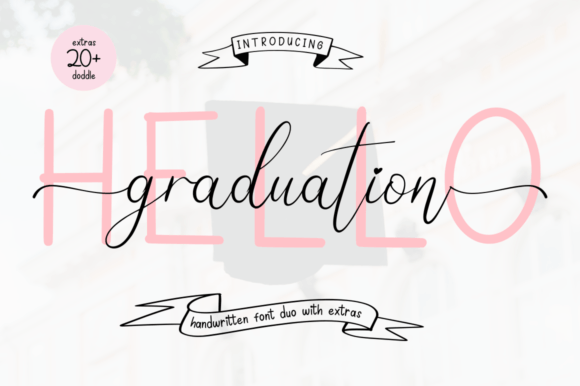
Hello Graduation stands out because it merges two distinct but complementary styles: a natural handwriting script and a clean, friendly sans serif—all in one family. That duality isn’t accidental. The script evokes sincerity and approachability—ideal for moments that call for human warmth, like graduation announcements, teacher appreciation cards, or indie music album art. The sans serif counterpart grounds those expressive moments with readability and structure, making it just as effective on a website header, app interface, or corporate presentation slide.
What makes Hello Graduation especially practical is its PUA (Private Use Area) encoding. This means every alternate glyph, swash, ligature, and stylistic set is accessible without complex OpenType setup—no plugins, no coding gymnastics. In tools like Adobe Illustrator, Figma, or even Canva (with custom font upload), you can open the character map and instantly insert a flourish, a connected “&”, or a contextual “th” ligature. For designers juggling tight deadlines—or non-designers building their first Shopify store—it removes friction without sacrificing nuance.
Where Hello Graduation Fits in Real Projects
This font doesn’t live in theory. It thrives where people make things happen.
- Educators and schools use Hello Graduation for end-of-year newsletters, classroom posters, and digital learning materials—its legibility at small sizes and expressive flair at large ones mean it works equally well on printed handouts and Zoom backgrounds.
- Small business owners—especially in apparel, wellness, and creative services—rely on it to shape brand identity systems that feel handmade but scalable. A boutique yoga studio might pair the script for its logo and the sans for service descriptions; a ceramicist could use both weights across Instagram Stories and product tags.
- Content creators lean into Hello Graduation for thumbnails, channel banners, and ebook covers. Its rhythm helps text breathe on screen, and its personality cuts through algorithmic noise—without looking forced or trendy.
- Publishers and authors apply it selectively: chapter titles in illustrated children’s books, comic speech bubbles, or limited-edition zine covers. It adds voice without overwhelming narrative flow.
More Than Aesthetic—It’s Strategic Typography
Typography isn’t decoration. It’s a silent communicator. Hello Graduation supports clarity by design: generous x-height, open counters, and consistent stroke contrast improve scannability—even at lower resolutions or on mobile devices. That matters whether you’re designing a festival lineup poster viewed from ten feet away or a blog sidebar read on a phone during commute.
Its versatility also reduces tool sprawl. Instead of licensing three separate fonts—one for headlines, one for body, one for accents—you get cohesive expression from a single family. That simplifies file management, speeds up client revisions, and ensures visual consistency across platforms: same font weight and spacing on your WordPress site, your Canva pitch deck, and your printed business card.
When to Reach for Hello Graduation (and When Not To)
Use it when you want to signal care, craft, or celebration—graduations, milestones, launches, community events, personal journals, or brand stories rooted in authenticity. It shines in contexts where uniformity feels cold and over-polished fonts feel distant.
Avoid it for dense legal disclaimers, technical documentation, or interfaces requiring strict WCAG AA+ contrast compliance at small sizes (though its sans serif variant performs well with proper color contrast). Also, skip it if your brand voice is strictly minimalist, high-tech, or institutional—Hello Graduation leans into humanity, not austerity.
Practical Tips for Getting Started
You don’t need advanced typography knowledge to use Hello Graduation effectively. Start simple:
- Define hierarchy first. Try the script for your main headline or logo—and the sans serif for subheads, captions, or buttons. Let contrast do the work.
- Test at multiple sizes. Preview how the script reads at 24px vs. 72px. You’ll notice where ligatures add charm (large display) and where the sans brings relief (small UI labels).
- Leverage PUA access intentionally. Don’t enable all alternates at once. Pick 2–3 glyphs that reinforce your message—a heart dot on an “i” for a love-themed project, or a tapered “t” for elegance.
- Pair mindfully. Hello Graduation pairs naturally with neutral sans serifs (like Inter or Manrope) or gentle serifs (such as Cormorant Garamond). Avoid competing scripts or overly geometric fonts—they’ll clash tonally.
And remember: licensing matters. Hello Graduation is typically offered with clear desktop, web, and app usage terms. If you’re embedding it in a SaaS platform or distributing via a plugin, verify the license scope—some versions include extended permissions, others require upgrades. It’s a small step that prevents future headaches.
Why Designers Keep Coming Back
Professionals return to Hello Graduation not because it’s flashy—but because it solves problems quietly. It bridges emotional resonance and functional reliability. It helps educators make learning feel inviting. It lets entrepreneurs express values without buzzwords. It gives illustrators and animators typographic texture that moves with their visuals.
In a landscape saturated with “hand-drawn” fonts that sacrifice legibility for quirk, Hello Graduation delivers both. It’s confident enough for a keynote slide—and tender enough for a handwritten note tucked inside a graduation gift box. That balance is rare. And it’s why, across studios, classrooms, and laptops worldwide, Hello Graduation stays open in design apps—not as a novelty, but as a trusted tool.